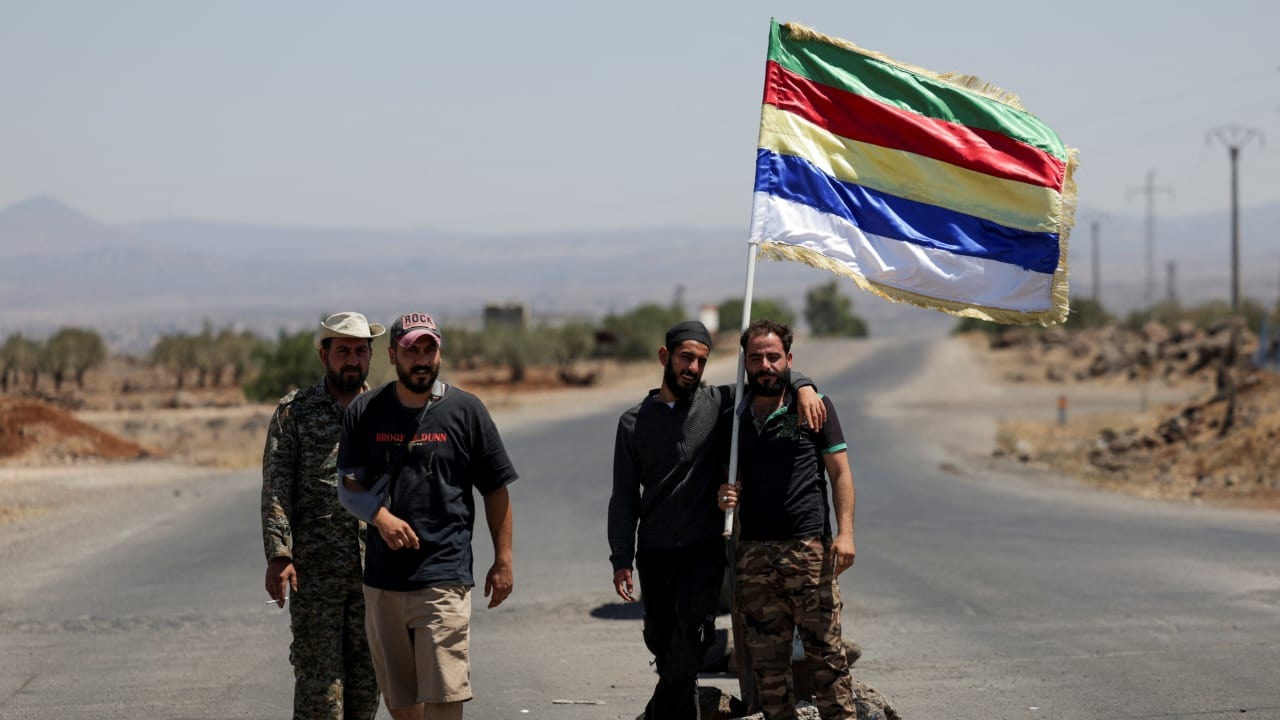

Syria has long been home to some of the world’s oldest continuous communities; the Druze, whose faith stretches back nearly a millennium, and the Assyrian Christians, whose roots in the region predate Islam by centuries. Both have survived empires, conquests, and civil wars. What they now face in post-Assad Syria, however, may be the most organized and systematic erasure yet. Since the fall of Bashar al-Assad in December 2024, a convergence of jihadist violence and state indifference, and in many cases, state complicity, has pushed these communities to the edge of extinction in their ancestral homeland.
The new Syrian government, led by Ahmed al-Sharaa, formerly known as Abu Mohammad al-Julani and a one-time leader of an al-Qaeda affiliate, inherited power through armed force rather than democratic mandate. While it is known that Assad’s rule was defined by mass atrocities, his secular authoritarianism state offered Syria’s religious minorities a fragile but functional shield against the jihadist factions that now govern his place, a bitter irony not lost on the Druze and Assyrian communities now bearing the consequences of transition, many Syrians celebrated with hope. According to Genocide Watch, since al-Sharaa’s seizure of power in December 2024, Hay’at Tahrir al-Sham (HTS), the terror group he was leading for a couple years, has largely put Alawite, Druze, and Christian civilians to “targeted killings, arbitrary arrests, abductions, sexual violence, destruction and seizure of property, forced displacement, and other atrocities”. The pattern is not incidental, it reflects a deeper ideological hostility toward communities whose beliefs fall outside Sunni Islamic orthodoxy.
For Assyrian and other Christian communities, the violence has been both spectacular and grinding. According to Open Doors USA, Syria has jumped to sixth place on the World Watch List (an annual report that shows where most Christian’s face persecution), reflecting that Syria is now at its most dangerous since ISIS occupied “significant swathes of territory”, with the interim constitution of March 2025 centralizing power in the presidency and establishing Islamic law as the main source of legislation. The constitutional framework itself signals where minorities stand: at the margins of a state that defines itself through a religious identity they do not share. As stated by PJ Media, Syrian education is being reformed according to Islamic teachings, eliminating pre-Islamic history and gender equality, and incorporating Quranic verses that negatively reference Jews and Christians, an effort to Islamize education and redefine Syrian identity. For Assyrians, a people who have carried Aramaic, the language of Jesus, into the modern world through their liturgies, the erasure of pre-Islamic history is not merely a political offense. It is a denial of their existence.
The violence against the Druze has been even more kinetic. Based on The Conversation, while many Sunni Muslims in Syria perceive the Druze as heretics, the Druze maintained a greater degree of distance from the Assad regime and were less integrated into its security apparatus, yet the situation in the Druze heartland deteriorated rapidly, with Druze militias and local Bedouin tribes engaging in heavy fighting in July 2025. That fighting, as documented by the UN Commission of Inquiry, left over 1,700 dead and 155,000 displaced. The violence was not simply tribal, it was enabled by a state that sent forces into Druze areas, committed atrocities, then withdrew without accountability.
What makes the current moment especially dangerous is the complicity embedded in how the state responds, or fails to respond, to these attacks. As reported by Christian Solidarity International, “the Druze, like Alawites and Yazidis, are seen as heretics by most Sunni Muslim scholars, and in Sunni jihadist ideology, it is considered acceptable or even obligatory to kill and enslave them”. When that ideology is held by the very security forces meant to protect civilians, the state does not merely fail minority communities, it becomes an instrument of their destruction. The House of Commons Library states that the transitional authorities’ own investigation into the March 2025 coastal massacres concluded that some interim government forces committed violations, but framed them as acts of “individuals” operating under “no official authority”, a finding the independent UN Commission reached similarly. Framing mass atrocities as individual misconduct is how states launder complicity into deniability.
The trajectory is one of slow elimination dressed as political transition. Communities that have prayed in Aramaic since the time of Christ, and communities that have maintained a unique esoteric faith in the Syrian mountains for a thousand years, are being dismantled, not all at once, but through accumulated displacement, targeted killing, cultural erasure, and institutional exclusion. The International Christian Concern says, while al-Sharaa assured the international community of his intention to establish a representative government inclusive of all religions and ethnic groups, the targeted attacks throughout 2025 justified the fears of many Christians and minority groups who were not convinced, and many continue to flee. When the ancient are driven from the land that made them ancient, what remains is not a new Syria. It is an emptied one.