
Earlier this month, the Milano Cortina 2026 Olympic Winter Games officially kicked off in northern Italy, accompanied by the familiar promise of global unity. The Organizers framed the Games as a “celebration of what unites us – of everything that makes us human”, invoking the Olympic ideals of peace, international cooperation, and compassion for all. Yet, even as the celebration unfolded, it was met with quieter tensions and the palpable taste of growing geopolitical pressures. Hosting the Games itself is not a neutral act. The immense infrastructure projects, security operations, and global sponsorship campaigns required to stage such an event often generate human rights concerns long before the first athlete competes, linking celebration to displacement, expanded policing, and the careful curation of a nation’s international image.
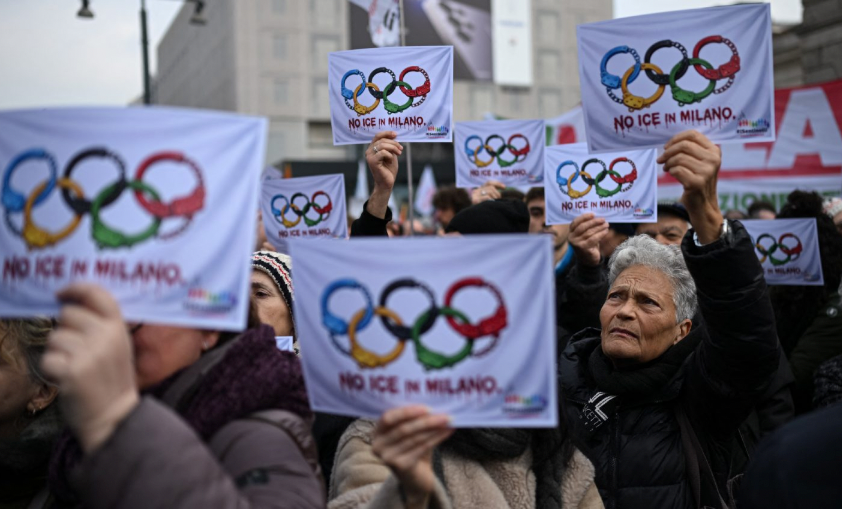
On the eve of the Opening Ceremony, Italian authorities announced heightened security measures amid protests against the presence of the U.S. Immigration and Customs Enforcement (ICE) agents at the Games. ICE officials have been the subject of extreme controversy in the United States, particularly around their role in President Donald Trump’s heavy-handed and violent immigration crackdown, lending to fears of ‘creeping fascism’ in the country.
The Olympic Games commenced within a broader week of sports spectacle. Across the ocean, the Super Bowl – an annual football league championship game of the United States – featured a record-breaking halftime performance by Puerto Rican artist Bad Bunny. Hailed as a landmark in cultural and political expression, the performance drew 133.5 million viewers to a simple but pointed statement: “The only thing more powerful than hate is love” (see video).
Together, these scenes underscored a familiar contradiction: sports are often presented as apolitical spaces of collective joy, yet they repeatedly serve as stages where power, identity, and human rights collide. For human rights advocates, this juxtaposition is a familiar one, reflecting deeper, recurring tensions embedded in the world of mega-sporting events. Large-scale athletic events like the Olympics often promise celebration and unity, but their preparations have repeatedly been linked to documented human rights concerns, ranging from housing displacement and labour exploitation to restrictions on freedom of expression.
Mega-Sporting Events, Politics, and Human Rights
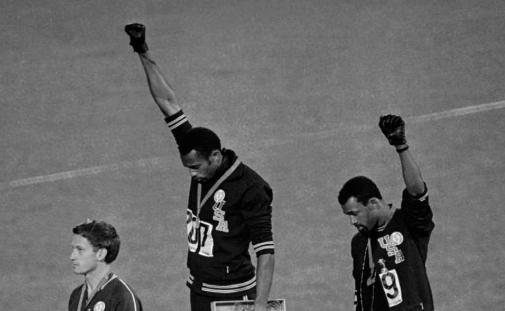
Mega-sporting events, such as the Olympic and Paralympic Games, and the FIFA World Cup, have long been seen as catalysts for national pride, global recognition, and economic growth. While these events bring undeniable excitement and spectacle, they have consistently been platforms for political expression and human rights advocacy. On the more extreme end of the spectrum, we have the 1936 Winter Games hosted by the Nazi Regime in Germany. More recently, we can recall athletes raising their fists on Olympic podiums during the civil rights era, to more recent gestures protesting racial injustice, war, and discrimination.
These mega events offer rare moments of visibility and bring together audiences across borders, languages, and political systems. With billions watching, athletes and performers have used these stages to amplify causes that might otherwise remain marginalized. However, as powerful as these events are for social transformation, human rights and investigative journalists have documented these platforms being used by States (and private corporations) to enhance their global image. This practice has come to be known as ‘sportswashing’ – oppressive governments using sporting events to legitimize themselves and overshadow their human rights abuses.
According to Amnesty International and Human Rights Watch, preparations for past Olympic Games by the host countries have often involved violations of the right to adequate housing, unsafe labor conditions for construction workers, and expanded policing powers that restrict freedom of assembly and expression. In multiple Olympic host cities, residents – often low-income or marginalized communities – have been displaced to make way for venues, transportation projects, or “beautification” efforts. Laborers, including migrant workers, have reported unsafe working conditions, wage theft, and limited avenues for legal recourse. Protesters and journalists have faced restrictions under the banner of maintaining public order and protecting the image of the Games.
“These events concentrate power and attention in ways that make rights protections especially vulnerable,” one Human Rights Research Centre report on mega-sporting events noted, warning that exceptional security and planning regimes can normalize practices that would otherwise face public resistance.
A Brief History of Sportswashing and the Olympic Games (among others)
The 2008 Beijing Olympics, for example, drew widespread attention to forced evictions and restrictions on free expression, even as China used the Games to project an image of modernity and global integration. In Sochi, preparations for the 2014 Winter Olympics were marked by environmental damage, labor abuses, and the silencing of dissent, alongside a massive investment in national prestige.
Rio de Janeiro’s 2016 Olympics saw tens of thousands of residents displaced from informal settlements, while heavy policing disproportionately affected Black and low-income communities. In Tokyo, labor concerns and transparency issues surfaced before and after the delayed 2020 Games, raising questions about who bore the costs of hosting. Furthermore, the 2022 Winter Olympics in Beijing hid a number of human rights violations, including allegations of genocide and crimes against humanity against Uyghurs and other Turkic minorities in the Xinjiang region, repression of religious freedom in Tibet, and the suppression of sexual assault allegations by tennis player Peng Shuai.
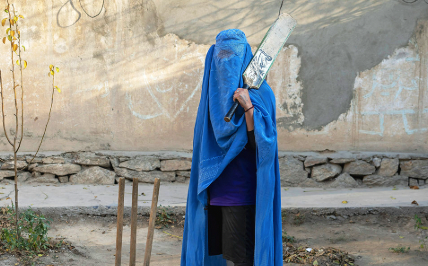
The Olympics are not the only sporting events with blood on their hands. The 2022 FIFA World Cup in Qatar came at the cost of deaths and abuses of migrant workers to build the tournament. Similarly, the 2024 ICC Cricket World Cup faced significant backlash for allowing Afghanistan’s national men’s team to compete, despite the ICC regulations stating that only countries with both a national men’s and women’s team were permitted to compete. The National Women’s Cricket team of Afghanistan was officially disbanded following the 2021 Taliban takeover of the country.
Despite differences in context, these cases share striking similarities. In each, organizers emphasized the temporary nature of extraordinary measures. In each, rights groups warned that the effects would last long after the closing ceremonies. And in many cases, those warnings proved accurate.
Human Rights Watch at Milano-Cortano 2026
Against this backdrop, the launch of the Milano-Cortina 2026 Olympics takes on added significance. The heightened security measures announced amid protests, particularly around migration and policing, mirror dynamics seen in previous host cities. On the first full day of competition, an estimated 10,000 demonstrators marched in Milan to protest rising housing costs and environmental degradation, centering the unsustainability of the Games for residents of host cities.
Italy’s role as a gateway for migrants into Europe further complicates the picture. As debates over borders, asylum, and law enforcement intensify globally, the Olympics arrive not as a neutral celebration, but as an event shaped by (and shaping) these political realities.
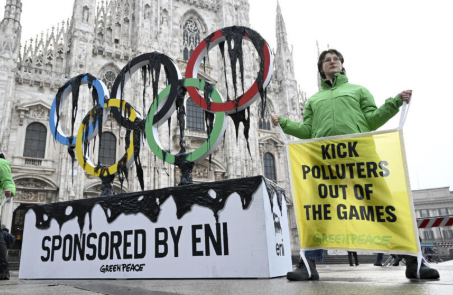
Concerns extend beyond policing. Environmental organizations, including Greenpeace, have criticized the sponsorship of the Games by fossil fuel giant Eni and questioned the sustainability of new infrastructure projects in fragile alpine ecosystems. Activists in Cortina d’Ampezzo have pointed to the felling of larch trees to construct a new bobsleigh track, carrying cardboard “trees” during demonstrations to symbolize environmental loss. While the International Olympic Committee (IOC) maintains that Milano-Cortina is largely relying on existing facilities to enhance sustainability, critics argue that the cumulative environmental footprint and long-term maintenance costs tell a more complicated story.
Athlete advocacy has also become a flashpoint. Ukrainian skeleton racer, Vladyslav Heraskevych, was disqualified after wearing a “helmet of remembrance” honoring athletes killed since Russia’s invasion of Ukraine, with the IOC citing Rule 50 of the Olympic Charter, which prohibits political demonstrations in Olympic venues. The decision prompted accusations of double standards and drew support from Ukrainian President Volodymyr Zelensky. Meanwhile, several U.S. athletes used press conferences (as permitted under Rule 50) to voice concern about political developments at home, illustrating the narrow boundaries within which expression is allowed.
The IOC has adopted human rights language aligned with the UN Guiding Principles on Business and Human Rights and requires host cities to include human rights clauses in their contracts. Yet, these enforcement mechanisms remain weak, relying heavily on host governments’ voluntary compliance and ultimately resulting in human rights consequences that extend far beyond the Games themselves. For example, research on the 2016 Rio Olympics found that approximately 6,600 families were either evicted or under threat of eviction as a direct result of preparations for the Games, with many relocated to distant suburbs and facing long-term disruption to their livelihoods and community ties. The environmental legacy of such events can also be profound. For the 2026 Winter Olympics alone, critics have documented significant ecological damage, including the destruction of century-old forests and the over-extraction of water from alpine rivers to produce artificial snow, straining fragile ecosystems and threatening biodiversity long after the competitions end.
These examples are warnings: what happens after the cameras leave is often the true measure of an Olympic legacy.
What Remains After the Cameras Leave
As the 2026 Winter Olympics come to a close, advocates say the question is no longer whether mega-sporting events affect human rights (they do) but whether governing bodies and host governments are willing to make protections enforceable rather than symbolic. According to Amnesty International, the danger lies not only in the abuses themselves, but in how effectively they are obscured and forgotten. If future Games and other large-sporting events are to break from this pattern, human rights due diligence must be binding, environmental safeguards must be independently monitored, and affected communities must be given meaningful avenues for remedy.
As the final medals are awarded and the world’s attention shifts elsewhere, the legacy of these Games will be measured not only in infrastructure or tourism, but in whose rights were protected – and whose were compromised – along the way.
Edited by Callixte Baron and Grace Neely.