
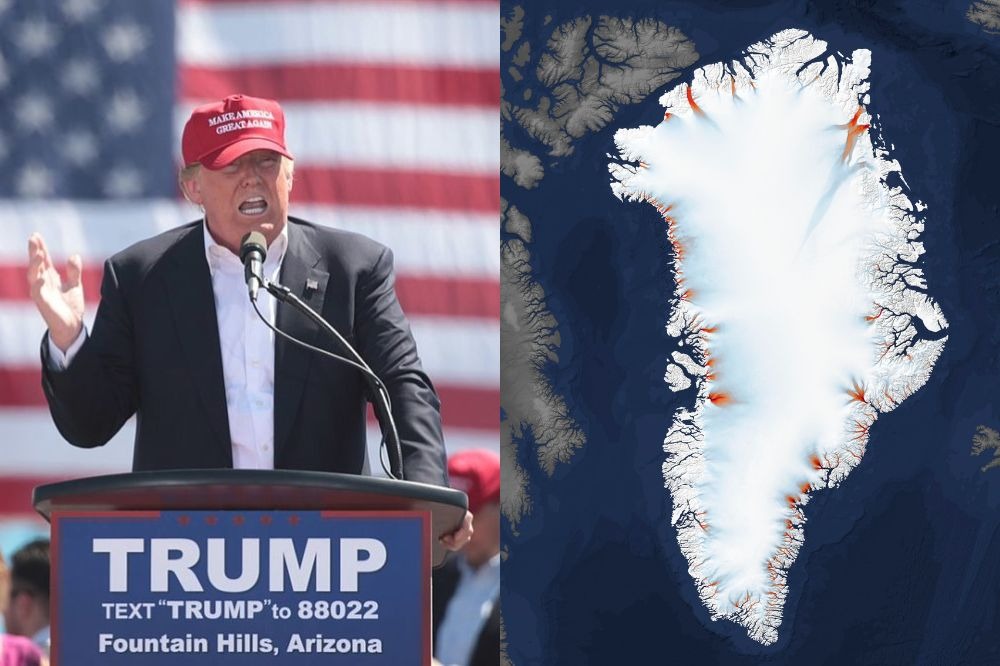
Donald Trump’s ongoing push for U.S. control over Greenland has often been treated as a bizarre geopolitical headline, a flashy story about a president wanting to “buy” a territory. But for the people of Greenland, this is not a novelty. It is a direct challenge to self-determination and Indigenous rights. What looks like strategy from D.C. can feel, on the ground, like a return to colonial legacy where powerful states can bargain over Arctic land as if they were empty and available.
The clearest lesson from Greenland’s reaction is this: Greenland is not a commodity, it is a homeland. Inuit leaders and organizations across the Arctic have been explicit that Trump’s language is not only offensive, but dangerous. In The Guardian’s reporting, Inuit Tapiriit Kanatami President Natan Obed describes the renewed U.S. interest in Greenland as echoing “centuries of imperialism,” the historical pattern in which Indigenous communities are pressured, displaced, or ignored when powerful outsiders decide their lands are strategically valuable. This perspective shows that Trump’s Greenland “plans” cannot be evaluated solely through diplomacy or military policy. They must be evaluated from a human rights lens, especially the rights of Indigenous Peoples to govern themselves and determine what happens to their territory.
A central human rights problem in Trump’s approach is that it treats Greenland as something that can be controlled rather than a people who must be consulted. Reuters reported that Greenland’s prime minister, Jens-Frederik Nielsen, warned that even though Trump has backed away from threatening military force, the U.S. still seeks “paths to ownership and control over Greenland.” Even when language becomes more diplomatic, the goal remains political domination nonetheless. From a human rights perspective, that is the red flag. Control “from there,” as Nielsen put it, means decisions about Greenland’s future shifting away from Greenlanders themselves. It turns a democratic society into a strategic object. This fear is not abstract. Nielsen linked the political pressure to rising anxiety in Greenland, including children feeling the stress of adults, severe sleep problems, and a general uncertainty about what will happen next. He described the situation plainly as “completely unacceptable.” Human rights include not only formal sovereignty, but the right to live without the intimidation from foreign actors.
Trump supporters might argue that this is not colonialism because it does not conform to a type of conquest. However, modern colonialism rarely announces itself as conquest anymore. It appears through dog-whistles like “security arrangements,” “investment opportunities,” and “strategic partnerships,” where the hegemonic party sets the terms that the subordinate actor must adhere to.
The Guardian article illustrates that Arctic Indigenous leaders are deeply aware of this pattern. Inuit Circumpolar Council chair Sara Olsvig warned against portraying the Arctic as an “asset” or an “empty ice desert.” For Inuits, she stresses, it is not empty, it is a homeland that sustains culture, elders, youth, and future generations. Olsvig also rejects the basic premise behind Trump’s ideas, being that Denmark cannot “sell” Greenland, because Greenland is self-governing and not “owned.”
She offers one of the strongest human rights statements in the entire debate: “There is no such thing as a better coloniser.” That line captures what Greenlanders and Inuit organizations fear; that even if American rule seemed “more modern” or “more prosperous” on paper, it would remain dominant as outsiders decide priorities and manage resources based on their own political and economic agendas.
To understand why Trump’s fixation over Greenland, it helps to look at the strategic context that the BBC offers. Responsible Statecraft argues that Trump’s threats and Arctic ambitions reflect the American. Stress concerning Russian power and Arctic shipping routes. It emphasizes that Russia dominates much of the Arctic coastline and has built up military infrastructure in the region, while the U.S. footprint remains comparatively smaller. Greenland’s geographic position becomes crucial in that context as it is seen as a platform for surveillance, missile defence, and strategic control.
But here is the human rights issue: security logic is swallowing democratic logic. When powerful countries compete, Indigenous Peoples often become the first to lose meaningful control. The Guardian quotes Indigenous leaders warning that when geopolitics “get heated,” Indigenous rights are the first thing forgotten. This is not paranoia. It is history.
One of the most important points raised by Reuters is cultural, and it’s deeply understood at a human-rights level. Prime Minister Nielsen noted that for Greenland’s Inuit population, Western debates about land “ownership” clash with Inuit values. Under Greenlandic law, people can own houses but not the land beneath them, reflecting an Inuit concept of collective stewardship rather than individual or foreign possession. Trump’s rhetoric is almost the opposite: a worldview where land is property, where territory is acquired, and where greatness means possession. This is not only politically incompatible with Greenland’s autonomy, it is culturally disrespectful.
If Trump’s plans advance, even without invasion, here are some human rights violations that could occur:
- The erosion of self-determination, where the U.S. “control” would override Greenland’s democratic institutions and political voice,
- The militarization of daily life, where a bigger security footprint can reshape society around surveillance and defence priorities rather than community needs,
- Increased pressure for resource extraction. The Guardian reports concern over foreign interest in minerals and defence positions, which could intensify extractive development without meaningful local consent,
- Increased psychological harm, as Greenland’s leadership has already linked international pressure to measurable anxiety and uncertainty.
Greenland is not just navigating geopolitics, it is defending its right to exist as a people who decide their future. Trump’s fixation exposes the uncomfortable truth that in the modern world, Indigenous rights are often treated as secondary when hegemons feel threatened. The task now is to reject that logic, and insist that the Arctic cannot be protected by sacrificing the people who call it home.
Edited by Emma Ristic and Norah Nehme.